LASIK for Astigmatism in Raleigh: How Much Astigmatism Can Be Corrected?
Plenty of people learn that LASIK treats astigmatism and then run into a second question: what happens when the measurement is high? A companion article, Can LASIK Fix Astigmatism?, covers what astigmatism is and how the laser corrects it — this one covers surgeon capability.
How Do You Know if a LASIK Surgeon Can Treat Severe Astigmatism?
Three verifiable things determine whether a surgeon can treat severe astigmatism: the diagnostic equipment used to map the cornea, the astigmatism treatment range of the laser platform in the practice, and whether procedures beyond LASIK are available for measurements outside that range. All three are answerable before surgery. Fellowship training in refractive surgery covers each one.
Porter Ophthalmology maps the shape of the cornea in house at its Raleigh practice and offers all five modern refractive procedures, so a patient with astigmatism is measured first and matched to a procedure second. Dr. Isaac Porter, MD and Dr. Bhumi Kinariwala, MD are both fellowship-trained in refractive surgery.
What Amount of Astigmatism Counts as Severe for LASIK?
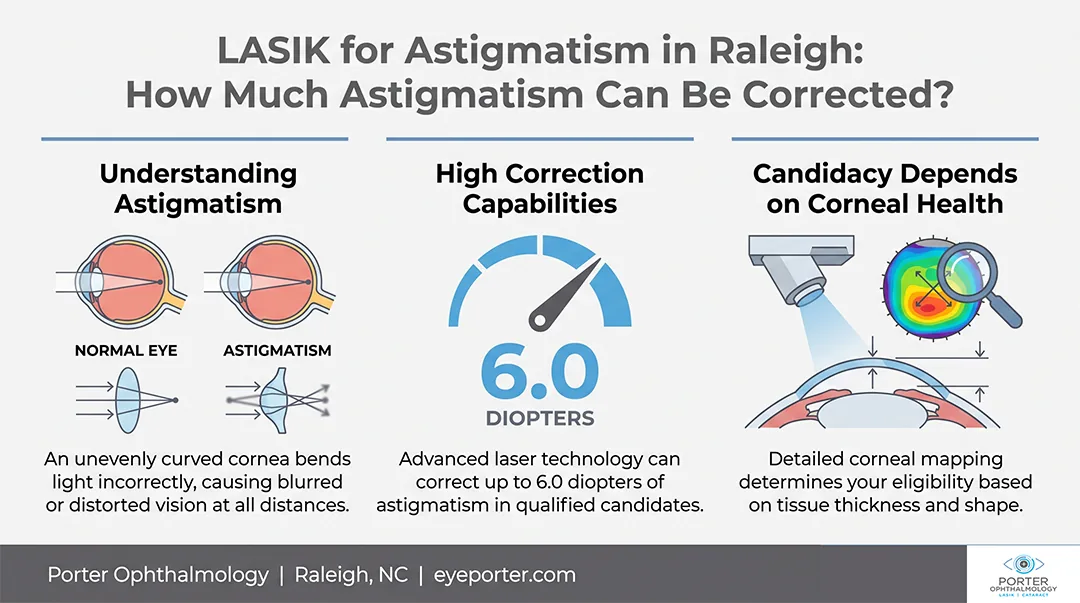
Severe astigmatism generally starts above about 3 diopters. Astigmatism is measured in diopters, with up to 2 diopters counted as mild to moderate and 2 to 3 diopters as significant. As of 2026, the excimer lasers used for LASIK are approved to treat astigmatism up to roughly 6 diopters, so most severe astigmatism still sits inside the treatable range. These thresholds describe measured corneal astigmatism, not a glasses prescription alone.
At Porter Ophthalmology, that severity number comes from corneal mapping rather than from a glasses prescription, because the two can differ. Patients in Raleigh learn what their astigmatism measures in each eye and what the treatment range is for every procedure the practice offers.
How the laser corrects an astigmatic cornea, and what a diopter is, are covered in Can LASIK Fix Astigmatism?.
What Surgeon Training and Experience Matter Most for Treating High Astigmatism?
Fellowship training in cornea and refractive surgery is the credential that maps directly to high astigmatism, because it covers corneal shape analysis and astigmatic treatment planning beyond what general ophthalmology residency provides. Board certification confirms completed training and ongoing competency assessment. A surgeon who performs several different refractive procedures can also treat astigmatism that falls outside the LASIK range.
Dr. Isaac Porter, MD is fellowship-trained in cornea, external disease and refractive surgery, and double board-certified. Dr. Bhumi Kinariwala, MD is board-certified and completed a refractive surgery fellowship at Brinton Vision in St. Louis. Both practice at Porter Ophthalmology in Raleigh.
How Does a Surgeon Decide Between LASIK and SMILE for an Astigmatic Patient?
The decision often rests on the measured amount of astigmatism. LASIK carries the wider approved astigmatism treatment range, which makes it the usual choice when astigmatism is high. SMILE treats astigmatism through a smaller corneal incision and carries a narrower approved range. Corneal thickness also helps inform the choice.
What Are the Options if Astigmatism Is Too High to Be Treated With LASIK?
Astigmatism above the LASIK treatment range is corrected with a lens-based or surface procedure instead of corneal laser reshaping. EVO ICL places a corrective lens inside the eye to treat astigmatism. Lens Replacement, also called refractive lens exchange or RLE, replaces the eye’s natural lens. PRK remains an option when corneal thickness is the limiting factor.
Porter Ophthalmology is the only practice in the Triangle offering all five modern refractive procedures — LASIK, SMILE, PRK, EVO ICL, and Lens Replacement (RLE). A patient whose astigmatism falls outside the LASIK range is evaluated across all five in a single visit.
Can Astigmatism Come Back After LASIK?
Astigmatism corrected with LASIK is long-lasting for most patients, and a measurable return is uncommon. When a return does occur, it reflects the cornea’s healing response rather than a failure of the treatment, and higher initial corrections carry more of that risk. A stable prescription before surgery is the strongest predictor of a stable result afterward.
What Technology Do Raleigh Practices Use to Measure and Treat Astigmatism?
Raleigh refractive practices measure astigmatism with corneal topography and tomography, which map curvature across a broader surface of the cornea rather than at a single point. Treatment is delivered by excimer and femtosecond laser platforms with eye tracking and cyclotorsion control, which hold the astigmatic axis in place while the patient is lying down. As of 2026, both are standard for astigmatic treatment.
Porter Ophthalmology treats astigmatism at its on-site laser facility in Raleigh using the WaveLight EX 500 excimer laser. Measurement and surgery happen in the same building, so the astigmatic map used to plan treatment is the practice’s own.
What Should You Ask a Raleigh Surgeon About Their Astigmatism Experience?
Four questions establish a Raleigh surgeon’s astigmatism capability: what the astigmatism measures in diopters, what the treatment range is for each procedure offered at that practice, which procedures are available if the measurement exceeds the LASIK range, and what fellowship training the surgeon completed. All four are answerable from measurements taken at the visit.
Porter Ophthalmology offers free, no-obligation vision correction evaluations in Raleigh, and the astigmatism measurement is part of that visit. The practice has been named Raleigh’s Best Eye Surgeon — Silver winner — for three consecutive years, and has corrected vision in the Triangle since 1983.
Key Takeaways: LASIK for Severe Astigmatism
- Astigmatism above about 3 diopters is described as severe, and LASIK excimer lasers are approved to treat up to roughly 6 diopters.
- Fellowship training in cornea and refractive surgery covers corneal shape analysis and astigmatic treatment planning beyond general ophthalmology residency.
- Astigmatism above the LASIK range is corrected with EVO ICL, Lens Replacement (RLE), or PRK, depending on whether corneal thickness or astigmatism sets the limit.
- Corneal topography establishes the measured amount and axis of astigmatism, and cyclotorsion control keeps that axis aligned during treatment.
A free, no-obligation vision correction evaluation at Porter Ophthalmology in Raleigh measures the exact amount of astigmatism in each eye and identifies which of the five procedures that measurement supports. Both fellowship-trained surgeons review those measurements before anything is scheduled.
Medically Reviewed By:
Isaac Porter MD
Board-Certified Ophthalmologist
Fellowship-Trained Refractive Surgeon
Last reviewed October 21, 2026
Article Source : eyeporter.com/lasik/lasik-f...
