LASIK Age Limits: Are You Too Old or Too Young for LASIK in Raleigh?

Age is usually the first question people ask before a LASIK evaluation, and as of 2026 it remains the most misunderstood one. The answer has less to do with a birthday than with what an eye exam finds.
Does My Age Make LASIK a Poor Choice?
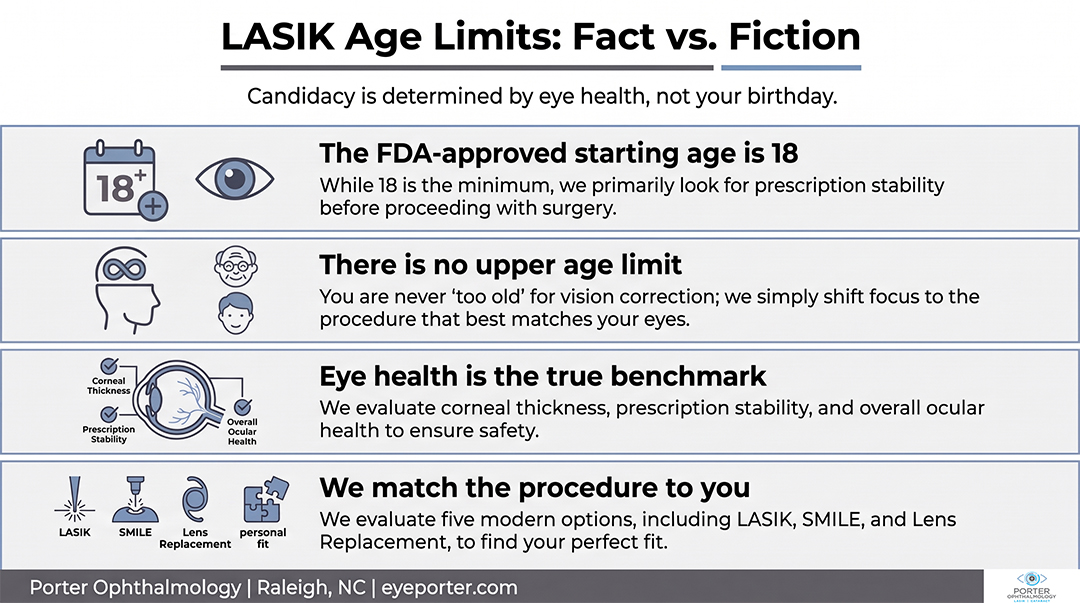
Age alone rarely makes LASIK a poor choice, because candidacy is determined by prescription stability, corneal thickness, and overall eye health rather than by a number. The FDA approves LASIK from age 18 and older. There is no upper age limit. What changes with age is not eligibility itself but which vision correction procedure is the appropriate match for a given pair of eyes.
At Porter Ophthalmology in Raleigh, Dr. Isaac Porter, MD, and Dr. Bhumi Kinariwala, MD are both fellowship-trained refractive surgeons who evaluate candidacy across all five modern refractive procedures: LASIK, SMILE, PRK, EVO ICL, and Lens Replacement (also known as RLE). That range means the evaluation asks which procedure fits a patient’s eyes, not which one happens to be available.
Is There an Upper Age Limit for LASIK, or Is Eye Health the Real Deciding Factor?
There is no upper age limit for LASIK, and eye health rather than age is the deciding factor for whether you are a good candidate for the procedure. Surgeons evaluate the cornea, tear film, retina, and natural lens. Patients in their fifties, sixties, and beyond proceed when those structures are healthy and the prescription is stable.
Both surgeons at Porter Ophthalmology in Raleigh completed fellowship training in refractive surgery and evaluate older candidates by the same measurements applied to everyone else. The result of the eye exam, not the patient’s age, sets the recommendation.
What Is the Minimum Age for LASIK, and Does Prescription Stability Matter More Than Age?
Current FDA guidance approves LASIK from age 18 and older, and prescription stability matters more than the birthday once that minimum is met. Surgeons typically look for a refraction that has held steady for at least twelve months, which is why some candidates wait until the early or mid-twenties. A prescription still shifting at age nineteen is a reason to wait. A stable one at nineteen is not.
How Does Presbyopia After 40 Change What LASIK Can Realistically Deliver?
After about age forty, LASIK still corrects distance vision but does not prevent presbyopia, the age-related loss of near focus. This loss of near vision will occur regardless of whether a patient undergoes LASIK. LASIK can still provide options, such as monovision or blended vision, which corrects one eye for distance and one for near, for patients who are interested in better near vision.
At What Age Do Surgeons Consider Lens Replacement (RLE) Instead of LASIK?
Surgeons generally begin considering Lens Replacement, also called refractive lens exchange or RLE, from the forties onward, when the natural lens starts to change. RLE replaces the eye’s natural lens with an artificial one, which can address both distance and near vision, while LASIK reshapes the cornea and leaves the lens untouched. The crossover point is set by lens condition, not by a fixed age.
Porter Ophthalmology in Raleigh performs both LASIK and Lens Replacement (RLE), so the choice between them isn’t shaped by which procedure is available. Dr. Isaac Porter, MD and Dr. Bhumi Kinariwala, MD decide between LASIK and RLE using measurements taken during the evaluation and looking at your eye health as a whole.
Which Age-Related Eye Conditions Can Disqualify Someone From LASIK?
Cataracts, severe glaucoma, advanced dry eye, and advanced macular degeneration are the age-related findings that can rule out LASIK. These conditions can be identified during an eye exam, including a dilated exam and additional eye testing, rather than predicted by age. A finding that rules out LASIK does not necessarily rule out other vision correction procedures.
What Does an Age-Related Candidacy Evaluation Involve at a Raleigh LASIK Practice?
An age-related candidacy evaluation at a Raleigh LASIK practice measures corneal thickness and curvature, maps the eye’s optical surface, and checks quality of your natural lens. The surgeon can examine the retina and natural lens, and the current refraction is compared against prior prescriptions to confirm stable measurements. The exam determines which of the modern refractive procedures the eye can support.
Porter Ophthalmology in Raleigh offers a free, no-obligation vision correction evaluation. Dr. Isaac Porter, MD, a fellowship-trained and double board-certified refractive surgeon, and Dr. Bhumi Kinariwala, MD, a board-certified ophthalmologist and fellowship-trained refractive surgeon, review the measurements before any procedure is discussed.
If Someone Is Told They Are Too Old for LASIK, Which Vision-Correction Options Remain Available in Raleigh?
Being ruled out for LASIK does not rule out other vision correction procedures. As of 2026, refractive practices in Raleigh offer PRK, SMILE, EVO ICL, and Lens Replacement (RLE) alongside LASIK. Corneal thinning, dry eye, and lens changes can each point toward a different procedure, which is why the options list is narrowed by findings rather than by age.
Porter Ophthalmology is the only practice in the Triangle offering all five modern refractive procedures: LASIK, SMILE, PRK, EVO ICL, and Lens Replacement (RLE). Patients who are not LASIK candidates are evaluated for the remaining four during the same free visit, with the goal of reducing or eliminating dependence on glasses and contacts.
Key Takeaways: Age and LASIK Candidacy
- The FDA approves LASIK from age 18, and there is no upper age limit; prescription stability and eye health determine candidacy rather than chronological age.
- Surgeons generally look for a refraction that has held steady for at least twelve months before proceeding with LASIK.
- After about age 40, LASIK still corrects distance vision but does not prevent presbyopia; patients corrected for distance generally still use reading glasses. However, there can still be options for great near vision quality with LASIK, including monovision or blended vision.
- Cataracts, severe glaucoma, advanced dry eye, severe macular degeneration, and corneal thinning can rule out LASIK, though other vision-correction procedures may remain available.
A free, no-obligation vision correction consultation at Porter Ophthalmology in Raleigh determines which of the five modern refractive procedures your eyes can support, at any age. Both fellowship-trained surgeons review your measurements before any procedure is discussed.
Related Resources
Medically Reviewed By:
Isaac Porter MD
Board-Certified Ophthalmologist
Fellowship-Trained Refractive Surgeon
Last reviewed September 9, 2026
Article Source : eyeporter.com/lasik/lasik-a...
